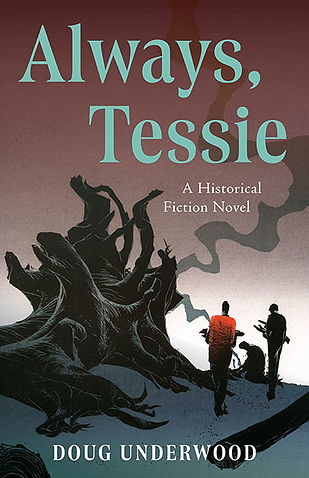
Always, Tessie (2025, 2026) creates what Underwood has studied: namely an historical fiction story about the plight of a 1960s young woman caught up in abusive circumstances in an indifferent man’s world.
Inspired by Thomas Hardy’s Tess of the d’Urbervilles, the novel is a modern reflection of how women have suffered, and sometimes healed from, the effects of traumatic abuse throughout history.
Always, Tessie is a 1960s version of a #MeToo story. A semi-fictional novel, it is about a young woman high school basketball player and her boyfriend who find themselves enmeshed in her story of hidden sexual abuse, recovered memory, and their discovery of a possible pathway to healing. Set in the Pacific Northwest, the story unfolds in a man’s world where sexual abuse typically was not taken seriously. Inspired by Thomas Hardy's Tess of the d'Urbervilles, it invites today’s readers to ponder what has and hasn’t changed in the circumstances of victimized women.
Published April 2025, 2026
Luminare Press
ISBN
Paperback: 979-8886796315
Hardcover: 979-8886796322
Review by Demetria Head for Reader Views (2026)
Always, Tessie by Doug Underwood is a historical fiction with some psychological and romantic elements. As the story opens, readers get to follow Derek and Tessie in a dual-perspective novel. It's 1966, and Derek is a teenager who's sneaking onto a country club golf course. He and his friends are getting deep into tense conversations about sexuality, class, and moral boundaries. At some point, he realizes that he's just enabled his so-called friend, Stu Nimmons, access to a neighbor's empty house for a date. Underwood allows this deeply uncomfortable narrative to shift into other territory involving Tessie inside that house. It triggers memories of her childhood and a disturbing experience involving her basketball coach and the adults who failed to protect her when she needed it most. This immediately sets the tone for how formative experiences can have a lasting impact and uncovers the silence and complicity within social and family confines.
Doug Underwood does a great job of vividly capturing adolescence in this story. The story moves through early high school years, then gradually into adulthood, each shaped by the past somehow. I love the early scenes painted around high school life in the 1960s, with late-night drives, parties, and even the conversations that lead to uncertainty rather than solid answers. When we get to Tessie's chapters, we feel all of the emotional weight that she carries, even as she gets on with life. Underwood brings out her traumas, her home life, the sense of fear and panic surrounding her stepfather. I think her part of the story will really resonate with readers who've had similar experiences. It deepens the narrative and puts private trauma and social constraints on full display. The content in her chapters and throughout the story may be triggering for some, but it is done in a way that doesn't romanticize any of it. But I love how Underwood uses Derek's character to give Tessie the safety she feels with him early on.
As the novel progresses, we see the main characters mature at a gradual pace over the course of the story's dual perspectives. I love how Underwood did not make this transformation sudden. It makes their growth more believable. Derek, as a teenager, is observant and intellectually restless. But Derek, as an adult, is more reflective and realizes that he hadn't fully grasped the emotional weight Tessie was under. He actually realized his blind spots over time.
Tessie goes through more of an internal and emotional evolution. She's shaped by fear, having to adapt, and silence. But she learns how to reclaim herself through having to remember her past traumas and journaling. The other characters, such as Stu Nimmons, Roderick Weir, Arnie Akers, and Deb Grosvenor, were shaped pretty well by Underwood, not merely as having static presence, but they represented the social constraints for the period, along with gender expectations and moral evasions. They also served as Derek's and Tessie's mirrors in a sense, especially pertaining to culture, rivalry, and friendships.
This story carries a reflective tone that is very appropriate for the nature of the narrative. We see how some of the friendships in the story are altered or how Tessie is guarded at first, especially around male attention. What made this book so profound for me was mainly Tessie's part of the story, especially when we see her go from this confused girl, now a woman, who can reach back in time and name what happened to her and how it affected her. I also love how the ending doesn't offer closure in this neat little package with a bow. But how Derek and Tessie are shaped is through natural conversations, quiet introspective scenes, and a reckoning with the past, but not necessarily a concrete resolve. The letter Tessie wrote addressing Deb, Derek's arrest, and the no-contact order was some really hard gut-punches for me. These scenes show love is there, but now there's also damage control; consequences are beginning to reshape character identities. Tessie is beginning to test her own language power. These chapters, right before Derek's and Tessie's epilogues, are very powerful.
Always, Tessie is an emotional and social narrative, not just historical. Readers who can appreciate character-driven novels with this type of context, like The Girls of Atomic City by Denise Kiernan, will find so many reasons to pick up Always, Tessie. It's not about earning a victory near the end but actually feels more like a self-defining moment, especially for Tessie. Readers who love to see characters grow through uncomfortable but believable steps will have every reason to appreciate what Underwood did with this story.
Book origin
I wrote an early version of Always, Tessie as a coming-of-age novel when I was in my twenties before I knew much about the role of trauma in life. My agent, Jean V. Naggar, circulated the book with multiple New York publishers where it was almost taken by Harper’s and Farrar, Straus and Giroux but ultimately didn’t make the cut. At the time, I was developing a promising journalism career in Washington, D.C., and I set aside my novel writing. Throughout my years as a journalist and university journalism professor, I worked or studied with or taught a host of successful published novelists, writers, and literary journalists – Jim Fallows, Tim Egan, Bill Keller, Ernest Lockridge, Barry Siegel, Harry Stein, Stephen Gettinger, Sibella Giorello, Bill Dietrich, Eric Nalder, Jill Leovy, Geoff O’Gara, Darcy O’Brien, Stuart Loory, Joe Nocera, David Hoffman, Mike Isikoff, Terry McDermott, Tom Guillen, and Carlton Smith. But I found that my own fiction-writing ambitions had pretty much faded away, despite my mother and my grandmother's backgrounds. They both published fiction for young adults, and sometimes left me feeling that if you don’t write a novel, life has no meaning. Then along came the COVID pandemic, and one day an old copy of the manuscript arrived in my mailbox. A longtime DC writing friend had discovered it when he was down-sizing for retirement. Apparently, I’d given the manuscript to him when I’d asked for criticism and editing help those many years ago. With more quarantine time at home, my novel-writing aspirations flickered up again. Two things struck me as I re-read the original version. (I knew I must have had a copy of my own somewhere in my cluttered storage space, but I couldn’t be sure.) One was my specializing in trauma studies, where I had written an academic book about trauma’s influence on young writers’ lives. I also had been teaching creative nonfiction at the UW for more than 20 years, and I had developed some effective strategies to improve students’ creative writing. What might happen, I wondered, if I applied my own teaching techniques and my new knowledge about trauma to my long ago fiction writing (which certainly was in need of re-plotting and revision)? The result is Always, Tessie. This version is probably 70 or 80 percent new writing. But an important part of the book comes from segments of the old manuscript when I was closer in age to my protagonists and their friends and how they thought and felt. In particular, I feel that the dialogue benefited from having much of it written when my youthful ear was better attuned to the language of the times.
My original manuscript only had the voice of Derek narrating the story. When a friend steered me to former New Yorker staff editor, Brenda Peterson, who took me on as a writing client, her biggest piece of advice was to add the voice of Tessie to the book, given the cultural changes that have reshaped the landscape of fiction writing. At first, I was reluctant that I didn’t have the writing chops or the imagination to do it. But to my surprise and satisfaction, I found it comfortable to create a young woman and young man as multiple narrators, and I feel it improved the book. This device isn’t unique to me. But given that my hope has been to promote empathy, reconciliation, and trust between the sexes, the tone of Always, Tessie is milder and perhaps more hopeful than other harder-edged trauma texts emphasizing revelation, victimhood, and grievance.